EV Charging Station Load Management: What Commercial Site Hosts Need to Know

As electric vehicle adoption accelerates, many commercial properties are discovering that installing EV chargers can present an electrical capacity challenge.
Office buildings, multifamily properties, retail centers, municipalities, and even fleets often face fixed power limits that were never designed for simultaneous EV charging demand.
But thanks to EV charger load management, built into EV Connect Software+, site hosts now have an intelligent energy management solution that dynamically adjusts power flow and adapts to real-time driver needs and energy requirements.
As a result, hosts can install more charging stations without an electrical service upgrade.
What Is EV Charger Load Management?
EV charger load management is the practice of controlling how available electrical capacity is shared across multiple EV charging sessions to ensure total demand never exceeds a site’s power limit.
Load management is sometimes used interchangeably with “load balancing ” and “energy management.”
It can include:
- Enforcing site‑wide power limits
- Dynamically redistributing power as vehicles plug-in or unplug
- Prioritizing certain charging sessions (fleet vehicles, time‑based rules, access tiers)
- Adapting continuously to changing site conditions
For commercial site hosts, the objective is straightforward: maximize charging availability without overloading existing electrical infrastructure and avoiding costly upgrades.
- Instead of each charger drawing power independently, the system treats all chargers at a site as part of a coordinated network.
- When a new vehicle connects, or another finishes charging, the system recalculates and redistributes available power instantly.
This software‑driven coordination is what enables modern charging sites to expand efficiently within existing electrical constraints.
EV charger load management also helps customers curb energy use during expensive on-peak windows, stay under peak demand thresholds, and enable demand response participation.
EV Connect’s charging station management system (CSMS) is designed so that the load is balanced in real time using two mechanisms: Proportional or Fleet.
- Proportional Load Sharing: Each active session is provided with a proportional percentage of the available power limit, scaled by the rated capacity of charging stations.
- Fleet Vehicle Charging Optimization: Each active session is assigned with a power limit to meet fleet’s duty cycle need. When a fleet vehicle connects to a station, the EV Connect CSMS balances power limits across the station group to ensure on-time departure.
How Load Management Approaches Differ
Not all EV charging setups manage power the same way. Understanding the differences between basic charging, static load sharing, and advanced load management helps site hosts evaluate what level of capability is needed today—and what will scale tomorrow.
EV Charging Load Management Comparison
| Evaluation Area | Basic Charging Setup | Static Load Sharing | EV Connect’s Dynamic Load Management System |
|---|---|---|---|
| Power Control Method | No centralized control | Fixed caps set during installation | Software dynamically allocates power in real time |
| Response When a Vehicle Plugs In | No adjustment; site demand may spike | Limited adjustment based on preset rules | Automatic redistribution across all active chargers |
| Risk of Electrical Overload | High | Reduced, but still possible | Actively prevented |
| Ability to Add More Chargers Without Upgrades | Very limited | Somewhat limited | High — optimizes existing electrical capacity |
| Support for Mixed Charger Power Levels | No | Limited | Designed to handle mixed hardware |
| Support for Charging Priorities | No | Rare | Built‑in or configurable |
| Visibility Into Energy Usage | Minimal | Basic | Detailed analytics and real‑time monitoring |
| Scalability Across Multiple Sites | Not scalable | Limited | Designed for portfolio‑level management |
This progression illustrates why growing charging programs increasingly relies on software‑based load management rather than static electrical assumptions.
What Happens When an Additional Vehicle Plugs-in at a Charging Station?
The real value of load management becomes apparent the moment a new vehicle connects.
Without load management, a newly plugged‑in EV can push total site demand beyond safe limits—causing overloads, tripped breakers, or forced session interruptions.
- For example, in a basic charging setup with 100-amps of capacity shared with two 30-amp chargers and two 40-amp chargers, only three vehicles can charge at once (30-amps + 30-amps + 40-amps = 100-amps total).
- But with dynamic load sharing programmed into the CSMS, when a forth vehicle plugs in the system intelligently manages the available energy and proportionally adjusts the output so that all four vehicles can charge (21-amps + 21-amps +29-amps + 29-amps = 100-amps total).
Proportional Load Sharing Example
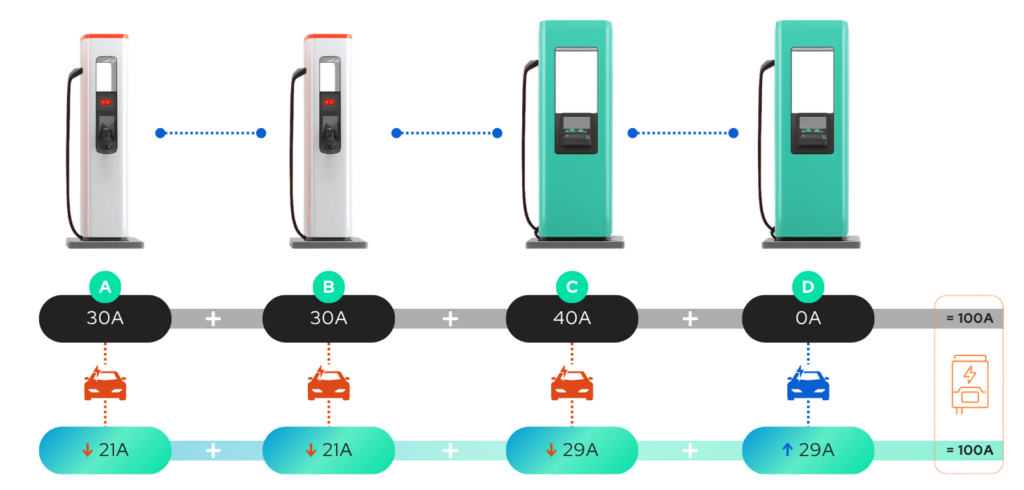
Above image: Two different 100-amp charging scenarios, with 4 vehicles able to charge when using a proportional load sharing design (bottom example).
Fleet Optimization Example
In a fleet charging scenario with dynamic load management, power is allocated to meet each fleet vehicle’s duty-cycle and on-time departure needs. In contrast to the above example, energy distribution is prioritized for on-time fleet vehicle departure instead of equal sharing among vehicles.
Note: This requires fleet managers to configure vehicle route information, and Level 2 charging additionally requires vehicle telematics.

Above image: When an additional fleet vehicle connects to a station, the EV Connect CSMS balances power limits across the station group to ensure on-time departure, which the fleet manager sets in the management console.
Additionally, fleet managers can delay charging to cheaper off-peak windows without dispatching any personnel to manually start a charging session. A start charge command will be automatically sent during the time window while a vehicle is connected to a charging station.
Dynamic Load Management Creates a Better EV Charging Experience
With EV Connect’s dynamic load management, available power is automatically redistributed across all active chargers. The new session begins smoothly, existing sessions continue without interruption, and the site remains within its electrical capacity.
Rather than designing infrastructure for peak theoretical demand, load management allows sites to operate efficiently under real‑world conditions.
Why Load Management Matters for Commercial Site Hosts
For commercial property owners and operators, effective load management directly impacts both cost and customer experience.
Key benefits include:
- Avoiding or delaying expensive electrical service upgrades
- Reducing the risk of overloads and downtime
- Delivering consistent, predictable charging for drivers
- Supporting future growth without redesigning infrastructure
- Gaining visibility into charging and energy usage across sites
Load management transforms EV charging from a constrained amenity into a scalable, reliable asset.
“EV Connect’s CSMS is designed to intelligently distribute available power among multiple charging stations in real time, preventing grid overloads, reducing peak demand charges and avoiding the need for costly infrastructure upgrades.”
– Nick Millar, Director of Product Strategy
Load Management as the Foundation for Scalable EV Charging
As EV charging evolves from single installations to multi‑station deployments, load management is no longer optional—it’s foundational.
“Commercial sites that plan for growth with dynamic, software‑driven load management are better positioned to scale confidently, control costs, and deliver dependable charging as EV adoption continues to accelerate.” Millar added.
About EV Connect
EV Connect is a full-service EV charging partner, offering end-to-end support from incentive guidance and site assessment to hardware, installation, software, warranties, and 24/7 customer support—all designed to simplify deployment and ensure long-term station reliability and performance.
Our 16+ years of charging expertise bring it all together seamlessly, backed by Schneider Electric, the world’s most sustainable company.*
Request a Quote or Contact Us today and find out why CPOs, OEMs, utilities, and more trust EV Connect to run their businesses!
*Schneider Electric was named “World’s Most Sustainable Company 2025” by TIME Magazine and Statista, and “World’s Most Sustainable Corporation 2025” by Corporate Knights.
Related Reading: